
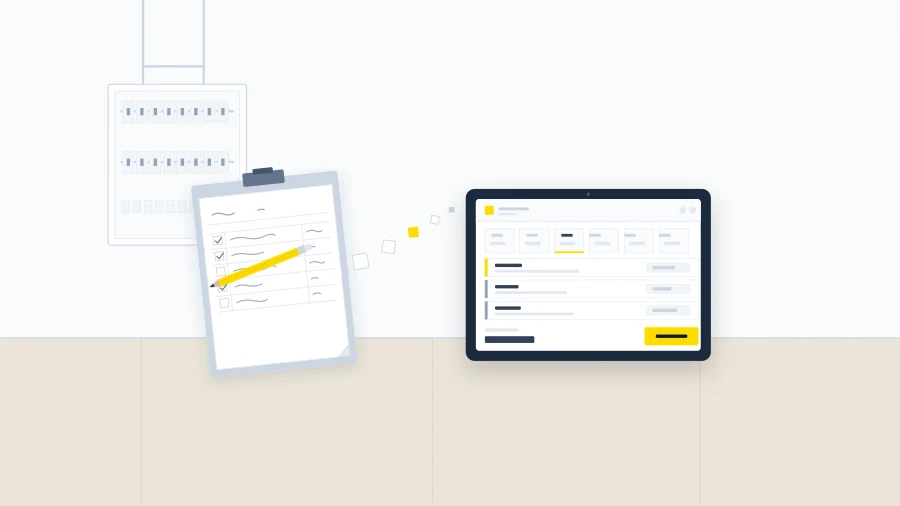
Reporting determines whether you end up with clean figures at the close of a project or whether everything has to be painstakingly reconstructed. Even so, in many electrical and building technology companies it still runs on paper, on notes left in the service vehicle or in a spreadsheet filled in on Friday evening. Digitising your reporting does not only win back time, it also delivers data quality that everyone can rely on.
This article shows where traditional reporting reaches its limits, what switching to a digital solution actually changes and what companies should keep in mind during the rollout.
What reporting covers
Reporting means recording the work performed on a job or a project. In a time report, working hours are at the centre, meaning the question of how long was spent on which job. Added to that are absences, which a person reports for themselves rather than booking them to a project, along with expenses and allowances that arise from the recorded hours.
A time-and-materials report is something different. It covers the tasks carried out and the material used, and it feeds directly into invoicing the customer. That part is usually handled by industry-specific solutions.
In everyday use both are simply called a report, yet they mean different things. Anyone looking to digitise their reporting should therefore first be clear about which of the two is meant.
Where paper-based reporting reaches its limits
Paper reports have one decisive drawback: the information is created on site but only recorded in the office days later. Details get lost in that gap. The technician can no longer remember exactly how long a particular task took or why a delay occurred.
On top of that comes the duplicated effort. Whatever is written on the note has to be typed up again in the office. That costs time, and errors creep in with every transfer. Transposed digits in the hours, illegible handwriting or a lost report mean the basis for invoicing is no longer correct.
In the end the post-calculation suffers. If the recorded hours do not match reality, there is no way to tell whether a job was profitable. The very figures that would matter most for steering the business are the least reliable ones.
What changes with digital reporting
With digital reporting, employees record their hours and services directly where they arise, usually through an app on their smartphone. The report is created in the moment of the work, not days later from memory. That alone raises accuracy considerably.
A second effect is speed. As soon as a report is captured, it is available in the office. Nobody has to collect notes or type them up any more. Approval and review happen digitally, and invoicing and analysis can be derived directly from the approved reports.
Transparency within the team also grows. Everyone sees the same data, queries can be resolved quickly and the status of a project is visible at any time. Reporting thus shifts from a tedious obligation to a reliable basis for decisions.
What companies should keep in mind during the rollout
The most important point is acceptance among the people out on site. Digital reporting only works if it is faster and simpler in everyday work than the old way. Capture has to be done in a few steps, otherwise it gets bypassed and the company ends up worse off than with the paper report.
A second point is the question of how deeply the solution should be embedded in the remaining processes. For larger companies it pays off to have an integration in which the captured data flows straight into invoicing, payroll and analysis. For smaller companies that can overshoot the mark. If only a handful of reports arise each week, simple digital capture without elaborate interfaces is often the more economical choice. What matters is matching the scope to the size and the actual workflows of the company.
Because time tracking is a business-critical process, it is worth approaching the switch deliberately. In our experience it helps to first name your own needs clearly and then, in a test phase for which you allow enough time, to check whether a solution actually covers those needs. If it fits, it is worth taking the step. A change always comes with a period of adjustment and new routines, yet in the long run it pays off in almost every case.